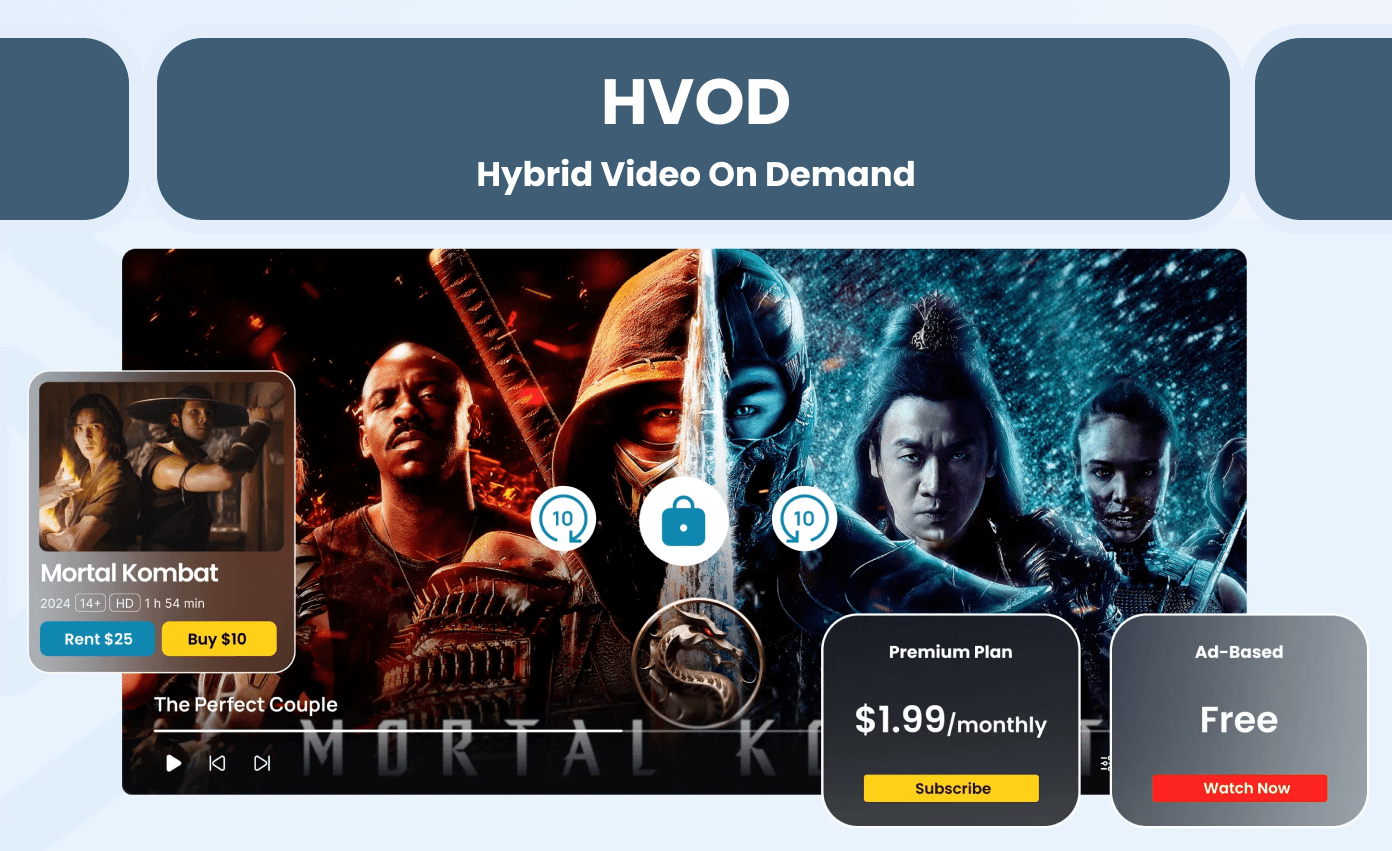
As streaming evolves, platforms are adopting **HVOD (Hybrid Video On Demand)** — a model combining subscriptions and ad-supported access. For OTT publishers, FAST operators, and content owners, HVOD offers a flexible, sustainable monetization alternative to pure SVOD or AVOD.
Introduction
As the streaming landscape evolves, platforms are experimenting with new ways to package content and generate revenue. One model gaining traction is HVOD (Hybrid Video On Demand) , a blend of traditional subscription models and ad-supported access. If you’re an OTT publisher, FAST channel operator, or content owner looking for sustainable monetization beyond pure SVOD or pure AVOD, understanding HVOD is essential.
This article explains what HVOD is, why it matters, how it compares to other monetization models, and how smart platforms are implementing it to grow engagement and revenue.
1. What Is HVOD? (Definition & Core Idea)
HVOD (Hybrid Video On Demand) refers to a video monetization model that combines subscription payments and advertising revenue. In other words: viewers pay a recurring fee and see ads during playback.
This hybrid approach sits between:
SVOD (Subscription Video On Demand) , ad-free access for a fee
AVOD (Ad-Supported Video On Demand) , free access with ads
With HVOD, viewers pay for access but still see ads , often in exchange for a lower subscription price or access to premium content.
Why it matters:
HVOD gives platforms more flexibility to balance user cost, engagement, and revenue , appealing to price-sensitive viewers who tolerate ads for a cheaper subscription.
2. How HVOD Works (User Experience & Tech)
Here’s a simplified flow of how HVOD functions on most platforms:
Subscription Enrollment
Viewers sign up and pay a subscription fee (monthly, quarterly, yearly).Personalized Ad Targeting
Once subscribed, the platform uses data (behavioral, demographic, device) to serve relevant ads within the content experience.Playback with Ads
Ads may appear:At content start (pre-roll)
During natural breaks (mid-roll)
After content ends (post-roll)
Ad Reporting & Analytics
Ad engagement, clicks, and conversions are measured for optimization and monetization insights.
From a technology standpoint, HVOD typically leverages SSAI (Server-Side Ad Insertion) because it creates a seamless playback experience , essential for paid subscribers who expect quality comparable to linear TV without buffering islands between ads and content.
3. HVOD vs SVOD vs AVOD: A Clear Comparison
Understanding HVOD’s value requires seeing it in context with the two dominant video monetization models:
Model | Cost to Viewer | Ads | Revenue Source | User Experience |
SVOD | Paid subscription | No | Subscription fees | Ad-free premium |
AVOD | Free | Yes | Advertising | Ad interruptions |
HVOD | Paid subscription | Yes | Subscription + Ads | Lower cost + ads |
Key insight:
HVOD sits in the sweet spot for platforms looking to monetize with both recurring revenue and advertising, without forcing users into a fully ad-only model.
4. Why Platforms Choose HVOD (Pros & Use Cases)
Here are the most common reasons streaming platforms adopt HVOD:
A. Broader Audience Appeal
Not all subscribers want a high-price ad-free experience. HVOD attracts:
Price-sensitive viewers
Users who tolerate advertising when content value is high
B. Dual Revenue Streams
Instead of relying solely on subscription fees or ads, platforms capture:
Recurring revenue from subscribers
Advertising revenue from each view
This can stabilize revenue and reduce churn.
C. Incremental Monetization
For long-tail content where pure SVOD doesn’t pay off, HVOD lets platforms generate incremental ad dollars without sacrificing subscriber commitment.
D. Flexible Packaging
HVOD can be used for:
Premium tiers with ads
Content bundles with different ad loads
Personalized ad frequency based on user tolerance
5. Tech & Operational Considerations
Implementing HVOD is not just a business decision , it has technical and operational implications that directly affect performance, ad monetization quality, and scalability.
A. Ad Delivery Technology
HVOD works best with Server-Side Ad Insertion (SSAI) because:
It offers seamless, broadcast-like playback
It reduces ad-blocker interference
It scales uniformly across devices (web, mobile, CTV)
By contrast, CSAI (Client-Side Ad Insertion) often leads to:
Buffer interruptions
Ad blockers skipping inventory
Fragmented reporting across devices
If your platform plans to monetize paying subscribers with ads, robust SSAI is a foundational requirement.
B. Data & Targeting
For HVOD to drive higher CPMs and engagement:
User data must inform ad targeting
Behavior insights (watch history, device type, geography) must flow into your ad decision logic
This requires integration between:
Subscriber management
Ad decision servers (ADS)
Personalization engines
C. Analytics & Attribution
HVOD’s hybrid monetization demands clear attribution:
How much revenue came from subscription?
How much from ads?
Which ad formats perform best for paid subscribers?
Building dashboards and reporting workflows around these metrics enables smarter pricing and inventory decisions.
6. When HVOD Makes Sense (Strategic Scenarios)
Here are typical scenarios where HVOD adds strategic value:
Scenario 1 , Price-Sensitive Subscriber Base
Your audience wants premium content but balks at high subscription prices. HVOD lets you reduce price and keep ads.
Scenario 2 , Mixed Content Value
Some shows are blockbuster hits; others have niche appeal. HVOD lets you monetize every asset more efficiently.
Scenario 3 , Emerging Markets
In markets where average revenue per user (ARPU) is lower, HVOD balances monetization with affordability.
Scenario 4 , OTT + FAST Hybrid Platforms
Platforms that operate both AVOD and subscription tiers can use HVOD as an intermediate upsell , enticing AVOD users into a paid tier that still shows ads but reduces frequency.
7. Risks & Tradeoffs to Consider
HVOD isn’t perfect for every platform , here are common trade-offs to weigh:
A. Subscriber Expectations
Paid subscribers often expect premium, ad-free experiences. HVOD must be positioned clearly to avoid churn.
B. Ad Tolerance
Not all subscribers welcome ads , some may prefer SVOD or ad-free tiers. This requires customer segmentation.
C. Technical Complexity
Integrations across subscription services, ad servers, and analytics stacks must be tight. Weak integration leads to:
Poor ad personalization
Tracking discrepancies
Suboptimal monetization
8. Revidd Perspective , HVOD as a Strategic Monetization Layer
At Revidd, we see HVOD as a powerful hybrid model for platforms that want diversified revenue and deeper engagement , but only when implemented with strong infrastructure and clear user communication.
Here’s how smart platforms implement HVOD successfully:
✔ Use SSAI as the ad delivery backbone
✔ Segment subscribers by tolerance and engagement
✔ Personalize ad loads based on behavior and content type
✔ Align pricing and ad frequency to perceived value
This ensures HVOD delivers both viewer satisfaction and predictable revenue , the core goals of any scalable OTT or FAST platform.
9. Final Takeaways
HVOD blends subscription payments with ad monetization , offering a middle way between SVOD and AVOD.
It can expand audience reach, stabilize revenue, and improve monetization , especially when supported by powerful ad delivery tech like SSAI.
Clear communication to subscribers and strong data integration are key to success.
If implemented strategically, HVOD becomes more than a pricing model , it becomes a growth lever for long-term engagement and revenue optimization.