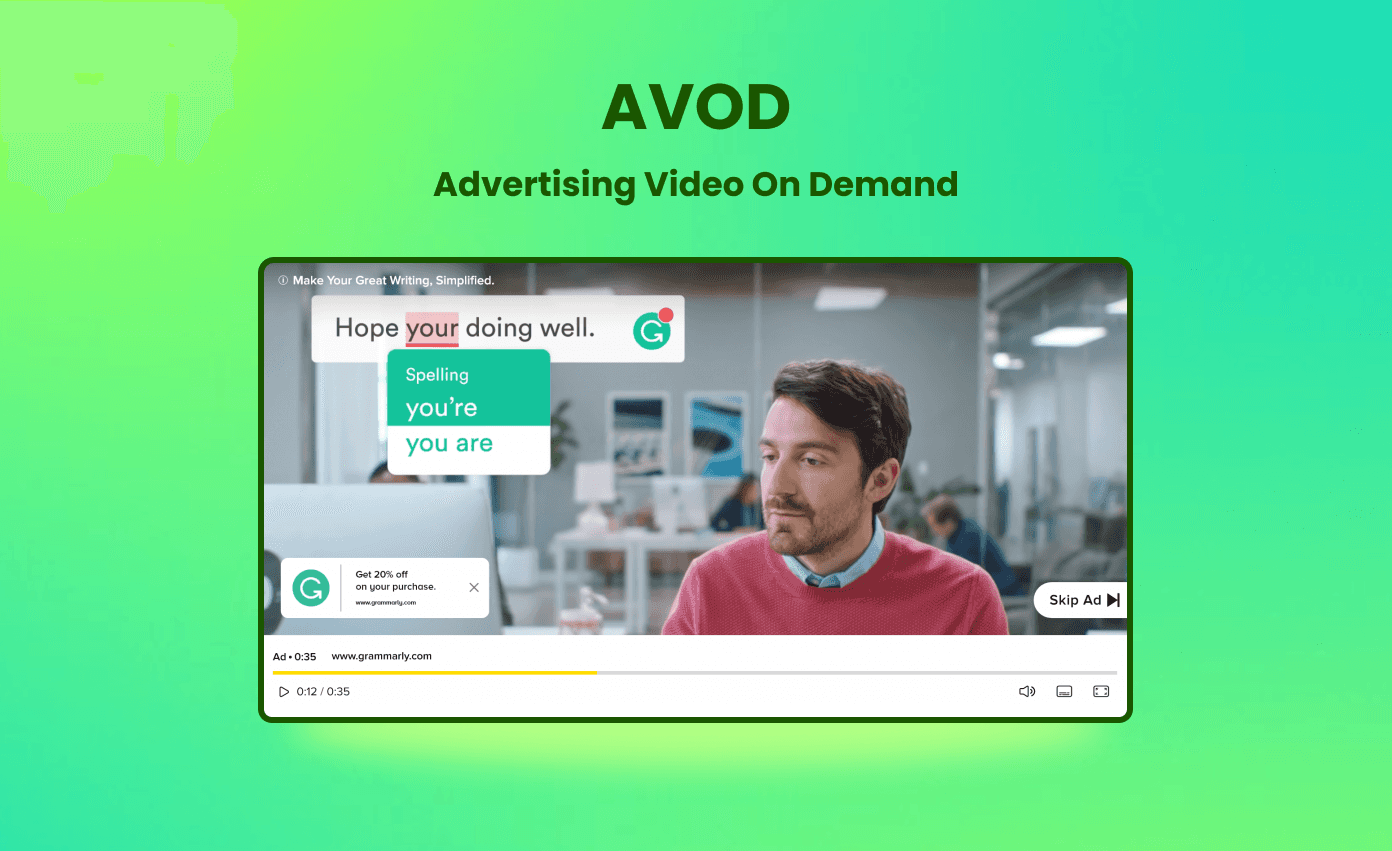
Advertising Video On Demand (AVOD) is a leading streaming monetization model, offering free content supported by ads. It balances audience scale with revenue generation, creating value for both viewers and platforms.
Introduction
Advertising Video On Demand (AVOD) has rapidly become one of the most influential monetization models in the streaming landscape. It allows viewers to access content for free while platforms earn revenue through advertising impressions , creating a win-win between scale and monetization.
In this article, you will learn:
What AVOD is
How AVOD works
The economics behind AVOD
AVOD’s pros and cons
How AVOD compares to other monetization models
What publishers must consider to succeed
Revidd’s perspective on AVOD infrastructure
Let’s dive in.
1. What Is Advertising Video On Demand (AVOD)?
Advertising Video On Demand (AVOD) refers to a streaming model where viewers can watch video content without paying a subscription fee, and the platform monetizes that content through advertising, typically by serving ads within or around the video experience.
Key characteristics of AVOD:
Free access for users
Revenue earned from advertising
Ads inserted via ad servers and decision systems
Works across web, mobile, and connected TV (CTV) platforms
AVOD contrasts with models like:
SVOD (subscription video on demand) , viewer pays a subscription; no ads
PVOD (premium video on demand) , one-time payment per title
FAST (free ad-supported streaming TV) , linear-like channels monetized by ads
In essence, AVOD turns viewership into monetization through advertisements rather than subscriptions.
2. Why AVOD Matters in 2026
AVOD has gained strategic importance in streaming for several reasons:
A. Subscription Fatigue
Consumers increasingly resist adding subscription fees for every service they use, driving them toward free, ad-supported options.
B. Exploding CTV Usage
Connected TV devices are now the most valuable screen for advertisers, and AVOD feeds directly into that ecosystem.
C. Advertiser Demand for Data
Advertisers are shifting budgets to platforms that offer measurable engagement , something AVOD on OTT and CTV delivers.
D. Scalability
Unlike SVOD, which depends on subscription growth, AVOD scales with audience size , making reach a primary driver of revenue.
3. How AVOD Actually Works (Mechanics & Flow)
AVOD monetization typically operates through a combination of streaming technology and ad decisioning. Here’s how it plays out:
A. Content Delivery
The video provider delivers content over streaming protocols such as HLS or DASH.
B. Ad Decision & Insertion
When a viewer plays a video:
The system makes a call to an ad server or ad decision server (ADS)
An ad is selected based on targeting logic
The ad is inserted into the stream
This insertion can happen via:
SSAI (Server-Side Ad Insertion) , ads stitched into the stream before delivery
CSAI (Client-Side Ad Insertion) , ads served by the player during playback
C. Viewing & Metrics
Ads display before (pre-roll), during (mid-roll), or after (post-roll) the content, and reporting is captured for impressions, completion, engagement, and revenue.
D. Payment from Advertisers
Platforms are typically paid:
Based on CPM (cost per thousand impressions)
Sometimes based on engagement or performance metrics
This turns viewership time into revenue without requiring user payments.
4. AVOD Economics Explained
Understanding AVOD economics helps platforms optimize monetization:
Revenue = Impressions × CPM
Where:
Impressions are the number of times ads are served
CPM is the price advertisers pay per 1,000 impressions
Two major factors influence revenue:
Audience Scale , larger audiences generate more impressions
Targeting Effectiveness , better targeting often yields higher CPMs
Platforms can also improve yield through:
Programmatic ad sales
Direct ad deals
Data-driven targeting
This makes AVOD a flexible revenue model that scales with both reach and data sophistication.
5. Common AVOD Ad Formats
Pre-Roll
Ads shown before the video starts.
High visibility and completion potential.
Mid-Roll
Ads shown during content.
Works well for longer content with logical breaks.
Post-Roll
Ads shown after content ends.
Lower engagement but useful for fill.
Overlay / Display Ads
Non-invasive banners or interactive elements within the player.
Sponsored Segments
Brand integrations placed contextually within content.
Each format has trade-offs in engagement and revenue , and the right mix depends on content type and viewer behavior.
6. AVOD vs Other Monetization Models
Here’s a snapshot comparison of the major streaming monetization models:
Model | User Pays | Ads? | Revenue Source | Best For |
AVOD | No | Yes | Advertising | Free access with scale |
SVOD | Yes | No | Subscription | Premium content libraries |
PVOD | Yes (per title) | Optional | Transaction & Rental | New releases, events |
FAST | No | Yes | Advertising | Linear, lean-back viewing |
AVOD vs FAST:
AVOD lets viewers choose what to watch with ads. FAST is scheduled linear-like channels with ads. Both monetize with advertising but serve different viewing experiences.
7. Pros and Cons of AVOD
Pros
✔ Free access drives scale
✔ Advertisers pay for impressions
✔ No subscription barrier to entry
✔ Strong fit for CTV and OTT ecosystems
✔ Data can improve targeting and pricing
Cons
✘ Revenue is tied to ad demand , not subscription stability
✘ Poor ad experiences can reduce engagement
✘ Requires strong ad delivery infrastructure
✘ CPMs can fluctuate based on market cycles
Understanding these trade-offs helps platforms balance user experience with monetization.
8. Key Metrics to Track in AVOD
To optimize AVOD performance, platforms must track:
Fill Rate
Percentage of ad slots that are actually filled with ads.
Low fill = lost revenue.
Completion Rate
Percentage of ads watched to the end.
Higher completion = stronger engagement and yield.
Viewability
Whether the ad was actually seen by users.
CPM / eCPM
Average revenue per thousand impressions.
Session Duration
Longer sessions create more ad opportunities.
Churn Impact
Analyzing ad load’s effect on retention.
These metrics help guide pricing, ad load strategies, and optimization priorities.
9. AVOD Implementation Challenges
Despite its advantages, AVOD has challenges that platforms must solve:
A. Ad Blockers
Without SSAI, ads may be blocked , losing revenue.
B. Device Fragmentation
Different SDKs and playback environments can cause inconsistent ad behavior.
C. Measurement and Attribution
Unifying measurement across devices and platforms is complex.
D. User Experience
Too many ads or poorly targeted ads can push users away.
Addressing these challenges requires robust infrastructure, cross-device testing, and data-driven workflows.
10. Revidd Perspective: AVOD as a Monetization Foundation
At Revidd, we see AVOD not as a fringe revenue stream, but as core monetization infrastructure , built into the platform from ground up rather than bolted on later.
Here’s how the right infrastructure makes a difference:
SSAI-Native Monetization
SSAI eliminates the risk of ad blockers and unifies experience across CTV, mobile, and web.
Data-Driven Targeting
When viewer behavior feeds into ad decisioning, you unlock higher CPMs and better yield.
Unified Metrics and Reporting
Cross-device analytics ensures advertisers and platforms see consistent performance.
Flexible Ad Formats
Pre-roll, mid-roll, and display ads can be mixed and optimized without breaking the user experience.
Platforms that treat AVOD as feature-level add-ons often see:
Lower fill rates
Revenue leakage
Inconsistent behaviors
Fragmented data
In contrast, AVOD built into the infrastructure stack , with SSAI, targeting, analytics, and delivery , scales more predictably and sustainably.
Final Takeaways
Advertising Video On Demand has become one of the most effective ways to monetize free streaming content , especially in a world where users resist paying multiple subscriptions and advertisers chase CTV impressions.
AVOD succeeds when:
Viewer experience is prioritized
Ads are delivered seamlessly (SSAI)
Targeting and data insights increase CPMs
Metrics are unified across delivery environments
For publishers and platform owners looking to scale reach and revenue, AVOD isn’t just an option , it’s often a strategic cornerstone.


