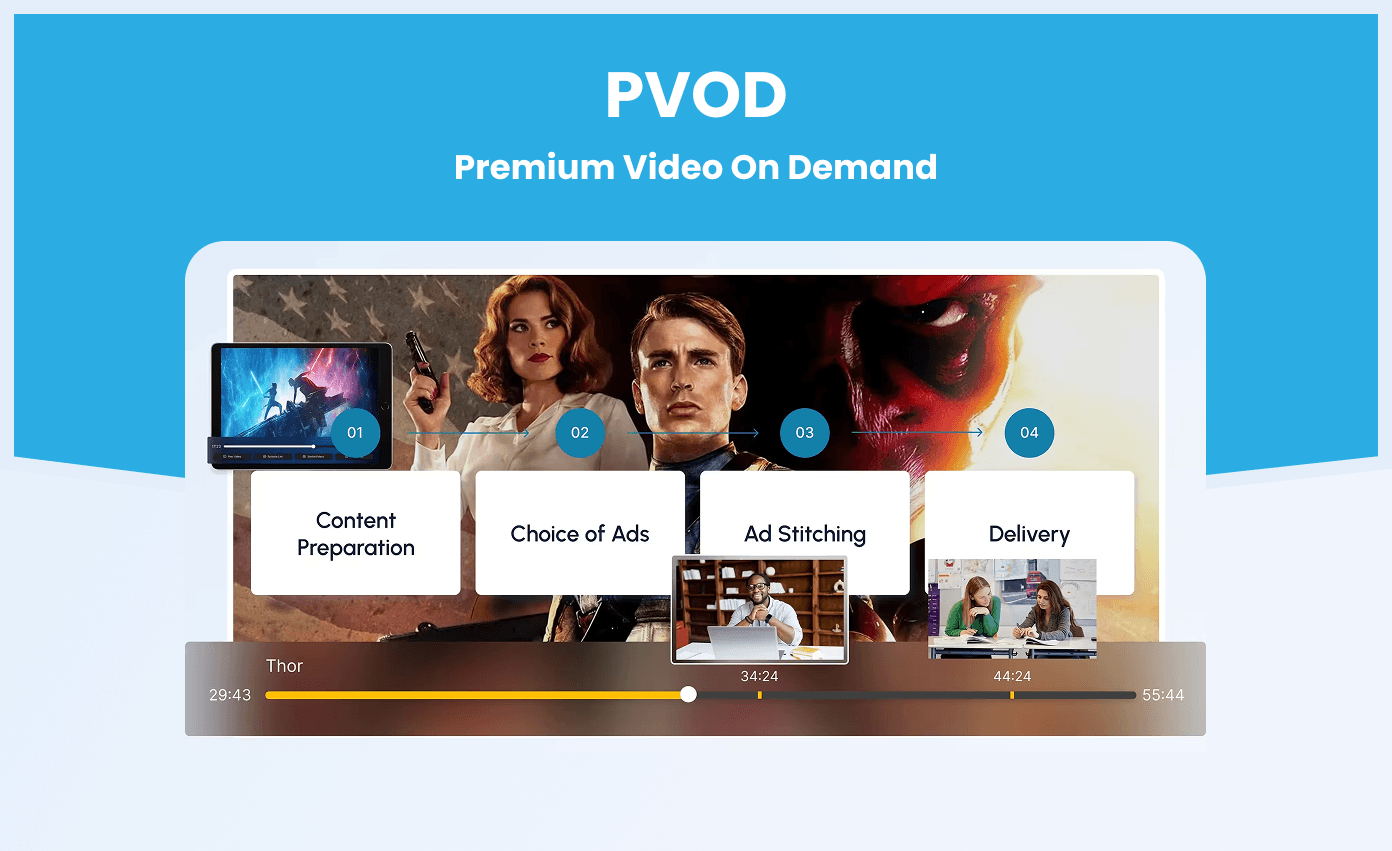
Premium Video On Demand (PVOD) blends pay-per-view economics with OTT distribution, offering high-value content at a one-time premium price. Ideal for movie releases, live events, and exclusives, PVOD enables immediate access without long-term subscriptions.
Introduction
As digital video ecosystems mature and audiences demand increasingly flexible consumption models, Premium Video On Demand (PVOD) has emerged as a powerful monetization strategy that blends elements of traditional pay-per-view with modern OTT distribution.
Unlike free ad-supported services or monthly subscription libraries, PVOD gives viewers access to specific premium content , typically at a higher price point , without a long-term commitment. It’s become especially relevant for movie releases, live events, exclusive content, and high-value programming where audiences are willing to pay for immediate access.
This article explains:
What PVOD is and how it works
How it compares to other video monetization models
Why it matters in 2026
Technical and operational considerations
Strategic use cases
Revidd’s view on PVOD infrastructure
Let’s begin.
1. What Is PVOD?
Premium Video On Demand (PVOD) is a video delivery model where users pay a one-time fee for access to specific premium content , typically movies, special events, or exclusive programs , during a defined rental or access period.
In contrast with other models:
SVOD charges a recurring subscription for wide access
AVOD offers free content supported by ads
PVOD charges a premium fee for a specific title or event
Example PVOD scenarios include:
Early theatrical movie releases available for home viewing
Live concerts or pay-per-view sports events
Exclusive series premieres
Special educational or one-time event content
In short, PVOD is transactional access to premium content , without a subscription commitment.
2. Why PVOD Matters in 2026
Several trends are driving strong interest in PVOD:
A. Content Value Fragmentation
Audiences increasingly want choice, not commitment. They are willing to pay per title for content they love, without subscribing to multiple libraries.
B. Movie Release Window Disruption
Studios are shortening or eliminating traditional theatrical windows. PVOD allows them to monetize premium releases directly to homes.
C. New Revenue Streams
PVOD adds a valuable revenue layer outside of subscription and ad-based models. For platforms with premium or exclusive library assets, it can yield significantly higher per-transaction income.
D. Global Distribution Without Territory Barriers
OTT delivery with PVOD allows global or region-specific pricing strategies without traditional broadcast licensing constraints.
As traditional media rights and studio economics evolve, PVOD fits as a flexible choice in the monetization stack.
3. How PVOD Works (Mechanics & Flow)
Here’s the typical viewer experience for PVOD:
Content Listing
The platform highlights premium titles available for PVOD rental or purchase.Payment Transaction
Viewer pays via the platform (one-time fee, rental window, or purchase).Access Granted
A token or entitlement is created on the backend.Secure Playback
The viewer watches the PVOD title during the access window (e.g., 24–72 hours).Expiration & Library Removal
After the rental window expires, access is revoked.
To support this workflow securely and reliably, the platform must manage:
Payment processing and entitlement records
Secure delivery with DRM
Entitlement enforcement across devices
Ad integration (in hybrid models)
PVOD is not just “paid content” , it’s a transactional entitlement workflow that must be managed end-to-end.
4. PVOD vs SVOD vs AVOD vs TVOD
To understand where PVOD fits, it helps to compare it to other popular models:
Model | Viewer Pays? | Ads? | Commitment | Access Type |
PVOD | Yes (one-time fee) | Optional | No subscription | Specific premium titles |
SVOD | Yes (subscription) | No | Ongoing | Full catalog |
AVOD | No | Yes | No subscription | Free catalog |
TVOD | Yes (transaction) | Optional | No subscription | On-demand titles |
PVOD vs TVOD:
Both are transactional, but PVOD typically implies premium pricing and exclusive content (e.g., new films, event access), whereas TVOD can involve lower-tier rentals or long-tail titles.
5. When PVOD Makes Sense (Use Cases & Scenarios)
PVOD is often used for:
A. New Movie Releases
Studios and platforms release films directly to homes at a premium price , bypassing theatrical windows or maximizing revenue before or during them.
B. Exclusive Live Events
Concerts, esports tournaments, or live shows where audiences are willing to pay for access.
C. High-Value Library Monetization
Titles with strong demand but limited subscription interest , such as classic films or curated collections.
D. Sports and Special Broadcasts
Pay-per-view boxing, wrestling, or unique sports events , sold individually rather than packaged.
E. Educational & Conference Content
Corporate or professional training content delivered at premium access prices.
6. Technical & Operational Considerations
Delivering PVOD successfully requires a robust infrastructure that handles:
A. Secure Entitlement Management
Once a user pays, the system must grant access , and enforce expiration , across devices.
B. DRM & Secure Streaming
Content must be protected to prevent piracy and unauthorized downloads. Multi-DRM support is essential.
C. Payment Integration
PVOD requires seamless integration with billing platforms and payment processors that work across global markets.
D. Playback Consistency Across Devices
Whether a user watches on mobile, web, or CTV, the experience must be reliable.
E. Analytics & Revenue Reporting
Platforms must track:
Transactions and conversions
Playback engagement
Revenue by title and region
Device behavior
PVOD workflows touch audience data, entitlements, ads (in hybrids), and delivery , requiring a tightly orchestrated backend.
7. Monetization Strategies for PVOD Platforms
There are multiple ways to derive revenue from PVOD:
A. Transactional Fees
The most direct model , viewers pay per title.
B. Time-Windowed Rentals
Charging premium access for a limited time (e.g., 48 hours).
C. Bundled Premium Packs
Offering packages of PVOD titles at a discount.
D. Hybrid PVOD + Ads
Some platforms allow limited ad exposure in PVOD content , trading a lower price for ad exposure.
E. Tiered Pricing by Region or Quality
Premium pricing for:
4K access
Early access windows
Regionally tiered offerings
Each of these strategies can increase ARPU while maintaining viewer value perception.
8. Common Pitfalls & Challenges
PVOD isn’t without hurdles:
A. Price Sensitivity
If prices aren’t aligned with audience expectations, conversions drop.
B. Entitlement Complexity
Tracking access windows across devices requires careful engineering.
C. DRM and Piracy Risk
Premium titles are high-value targets for piracy , requiring robust protection.
D. Integration Overhead
Entitlement systems must integrate across billing, delivery, analytics, and DRM.
Platforms with ad-based or subscription models that just “bolt on” PVOD often struggle , because PVOD success depends on infra-level integration.
9. Revidd Perspective: PVOD as Part of a Unified Monetization Stack
At Revidd, we see PVOD not as a standalone product but as a strategic monetization layer within a unified video infrastructure platform.
A successful PVOD offering requires:
Secure entitlement orchestration
Multi-DRM support
Consistent cross-device delivery
Analytics and revenue reporting
Seamless rollback to subscription or ad workflows
When integrated correctly:
PVOD increases ARPU without churn
PVOD increases content value without diluting subscriptions
PVOD unlocks premium rights monetization previously limited to theatrical windows
PVOD extends your platform into event and premium title economics
This is why Revidd’s infrastructure treats PVOD as a core revenue stream, not an add-on feature.
Final Takeaways
Premium Video On Demand (PVOD) is a highly strategic monetization model , sitting between subscription and free ad-supported services.
It offers:
Premium pricing for premium content
Flexible pricing strategies
Global or regional revenue optimization
Event and exclusive content economics
But it also demands:
Secure entitlement management
Multi-DRM and content protection
Consistent cross-device playback
Integrated analytics and reporting
In 2026 and beyond, PVOD will continue to play a crucial role for platforms that control premium content libraries, have access to high-value releases, or want to diversify revenue beyond subscriptions and ads.


